Tuesday, April 21, 2015

The Greenhouse: A Building with Many Stories

Photo by Marty Steeil

The Greenhouse of Teaneck, begun in 1953, is the only municipally-supported greenhouse in the State of New Jersey. Town Council records show that the Greenhouse is based in the refurbished Vandelinda Sewerage Treatment Plant.

 Adapting that building for use meant,  according to Council Minutes,  “covering the concrete vats, repairing the roof, and installing a heating system. ”The Garden Club of Teaneck took on cleaning up glass and debris, as well as fundraising, by asking for $25 per family to turn the site into a greenhouse. It opened up officially in January, 30 1954. Members organized by interest area work groups (i.e., herbs,  geraniums) and propagated plants for the use of the Township in parks and malls.

There were 31 original benches that were assigned in the opening year; all members paid dues of $3.00. Members who joined the Greenhouse needed to be members of the Garden Club, live in Teaneck and join a group to develop plants for the Township. These rules are used today still. Greenhouse Directors have included Gene Hubbard, Lou Schwartz, Dania Cheddie, Len Schwartz and Stephanie Murphy.

The Greenhouse has developed outreach activities in the community, such as their  education programs for children, now over 20 years in existence. It is finished for this year, and included students planting seeds and learning about a plant’s growth and parts.

The Garden Club holds an annual Plant Sale in the Greenhouse, this year from May 2nd to May 10th,. Container gardens, herbs, tomatoes, hanging baskets, vegetables, annuals, and more can be bought. To find sale hours, check:  http://gardenclubfteaneck.org   New this year are special demonstrations of interest to gardeners. You will see knowledgeable Garden Club members preparing soil, arranging potted plants and using color in landscape design. 

Tuesday, January 20, 2015

SOIL+ WATER plus ATTENTION = HERBS

SOIL+  WATER plus ATTENTION = HERBS
Getting Them Started in the Greenhouse

SOIL: Culinary herbs that we grow locally are rumored to do well in poor soil. This is a myth; herbs need nutrients to develop flavor and grow the cells that provide aroma and flavor (volatile oils), which comes from soil and sun. There are 17 types of soil in NJ; we will worry about that when we go outdoors. For germination indoors, we use a sterile medium to give the plant a head start.

Not for a while
STARTING FROM SEEDS: Some prepare a seed flat with soil and a lining of porous paper, such as newspaper, to keep the soil in the flat. Make sure not to dig them into an early grave! Plant a seed in a hole to a depth of 2-3 times the thickness of the seed. (experts vary.) Although the seed will huddle in the dark until it is ready, it will assert itself and break through the soil. Small seeds, such as Basil, Oregano, and Thyme can be placed on top of the soil and gently pressed into the soil, no layer on top. You can cover a seeded flat with plastic and place them away from light to germinate---the plant does not need light until it pushes forth. Then they need to develop that critical chlorophyll to absorb nutrition from the light (photosynthesis).

STARTING FROM CUTTINGS: When propagating Scented Rose Geraniums, use a sharp knife to make the diagonal cut on a tip stem, leaving 2 leaves. Do not enhance it with root hormone; there are chemicals in the cells that promote rooting. When there are two leaves on the stem of any seedling, separate the plantlets and place into small pots. You have a short window on plant health—they may overcrowd, and their root systems will entangle.


FERTILIZER: Another myth is that herbs do not need fertilizer. They will "make it", maybe, but why grow malnourished plants? Since the plants are in an enclosed space rather than outdoors, pay close attention to the dosage used.

WATER: When the plants are on a heated pad, you must watch the water moisture due to dryness; the seeds will dry out. If the plants are in a plastic wrapped flat, over moisture may cause seed rot. Think here of Goldilocks and the porridge that is “just right”. Some herbs are moistened by the random splashing of ocean spray. With the name, Rosemary, (ros= " dew” ,marinus= sea"), one would naturally infer that Rosemary can do well with only some spritzing and spare watering. Check the nature of the plant you tend.

NOW WHAT? Pay attention to the plant: water, feed, trim and have a good beginning to summer planting.  It is not much different when summer comes and these plants are outdoors.

But that is another story.

Friday, January 9, 2015

Seed Catalogs in January: My Short List of The Best

Picture from Roots Recipes Cookbook, Garden Club of Teaneck, P. Fromm


Brave Gardener  in Teaneck NJ  Community Gardens
n March 2014, No  doubt he will be doing this in March 2015.

SEED CATALOGS in January
To sleep, perchance to dream---this is not the best way to realize your garden dreams for 2015, no matter what Shakespeare said. It is time to look at catalogs and think of the first seeds to hit the ground in March. 

And why do we look at seed catalogs? To look at the gorgeous pictures, to believe our garden will look that good in July, to plan the best garden ever, especially after last summer’s are the usual answers. 

I looked at many a garden catalog to draw up my Short List of Catalogs I Cannot Do Without, with the necessity that herbs were included.

The Catalog with Beautiful Photos: Territorial Seed Company  
 The very best photo book costs a whopping $7.95, the company claims it is a new venture that goes beyond a catalog to a garden book. Their free catalog is chock full of pictures of rare and hard to find vegetables. A close second is the perennial favorite, Burpee Seeds. This one makes me itch to plant all those new hybrids so I have a rich tomato sauce with less tomatoes.

Most Information in a Catalog: Seed companies want to have their seeds germinate, and so they provide information on the best conditions for planting the seeds. Johnny’sSeeds had the most complete array of information on planting factors, just follow the instructions for successful germination. It was rated overall the top company in a Mother Earth article on the best sustainable seed company.

Second, there is the encyclopedic Well Sweep Farm catalog, with herbs grouped by Latin name. This serves as a handbook for herb lovers, with its complete varieties of Rosemary listed. And third here is Salt Spring Seedsfor its large collection of articles on seed saving and preservation for each vegetable.
www.saltspringseeds.com

 
Best Greens and Herbs from Asia: Kitazawa Seed Company has a wide array herbs from Asian countries, such as Vietnamese ones, such as Culantro Ngo gai  and Kinh Gioi,

Best Seed Packaging Most use paper seed packets, some are decorated elaborately (Renee’sSeed Company, uses original watercolors on the packets. Seeds of Change has a thick plastic packet with a zip-lock closing to keep the seeds from tumbling out or deteriorating.
 I have them from last season.

Attention to Cooking: No surprise, it is Cook’s   the other Warminster, PA seed company, has a collection of recipes in From the Cook's Garden that features the herbs grown from seeds in the catalog.  I bought it at a community garden conference, it has veggie-centered good recipes.

Monday, January 5, 2015

Seed Catalogs in January : Factors Affecting Germination


Picture from Roots Recipes Cookbook, Garden Club of Teaneck


MORE: Current factors considered important about seed production by companies 

GMO? 
The companies have taken pledges about using and selling GMO seeds. If this is important to you (and it is), look at the company’s literature---they are usually up front about this. Fedco is one example of "forthcomingness" about the seed mix, certification requirements, etc., and has a large collection of both culinary and medicinal herbs such as Blessed or St. Benedict's Thistle.


There is a Burpee’s letter about accusations of GMO and Monsanto ownership . Make up your own mind.

CERTIFIED ORGANIC?  
Be careful---several companies sell both Certified Organic and standard seeds, such as Territorial, and they do mark them. The Growers Exchange sells herb; the Company has taken the Safe Seed Pledge. For anyone who needs convincing to buy organic seed, look at High Mowing's  eloquent explanation.

SEEDS HARVESTED and STORED? Cold-stored. hand-harvested. Scarified? See what the company advertises and check with the Mother Earth Article listed below on Source Seed.


CATALOGS AND SITES THAT ARE EASY TO USE? 

Territorial Seed Company  has a free catalog, as most companies 

Fedco offers a downloadable catalog. Renee's is an  online catalog, Seeds of Change offers both a downloadable and a  print catalog. as does Southern Exposure Seed Exchange and Johnny Seeds...Other print catalogs given by request are High Mowing, Burpee Seed, and Cooks. 

Peaceful Valley provides requests for both print and downloadable current issues., as well as a subscription series. Print and .pdf versions are offered by  Kitazawa Seed Company (print, online and CD) and Seed saver's Exchange: (print, online and .pdf.)

Salt Spring Seeds http://www.saltspringseeds.com/ .Recipes for many of the vegetables are offered.

Burpee Seeds (www.burpee.com) Besides having a huge inventory of species, Burpee offers instructional videos. The  herb listing is moderate, look for markings of “organic “ for herbs and other plants. Headquarters in Warminister, PA.

Two sites  that need caution: Ferry Morse and Peaceful Valley. The latter  sells a Tarragon-Mexican, which is not related to French tarragon (Artemisia dracunculus), despite claims of tasting like it. However, further in the literature one can see the  difference.


Look carefully at any product labelled as "tarragon"---the Latin name will give it away. Tarragon  does not have true seed and is propagated through cuttings. Peaceful Valley sells a wide array of organic herb seed, as well as standard ones. The herbs are produced by both Peaceful Valley and other companies, such as Renee's. Ferry Morse is very difficult to navigate. 


Read more about other seed companies: 

The Directory of Sustainable Seed Companies, by Mother Earth News About 100 companies are profiled. 

Read about the top 15: The ones mentioned in this article

---see the rest of the 15. http://www.motherearthnews.com/organic-gardening/best-vegetable-seed-companies-zm0z11zsto.aspx#axzz3Nrw4ACTL

Read about quality seeds: Find out about what a seed actually IS and conditions affecting germination.
Source Seed: http://www.motherearthnews.com/organic-gardening/high-quality-seeds-zm0z14djzsto.aspx#axzz3LyZRzTag.


Thursday, November 27, 2014

The Twelve Herbs for the Holidays

Bedstraw


Our Lady’s Bedstraw at The Cloisters

Skylands is hosting a themed Christmas called:  “The Twelve Plants of Christmas.” 
Not to be outdone, I wish to install a virtual “Twelve Herbs of the Holidays.” 

The first four:” Parsley, Sage, Rosemary and Thyme”---they are of the refrain from the Simon& Garfunkle song from the Graduate (1969). Each has medicinal use and symbolic meaning.


It’s likely they were seasoning for your holiday meal. 

In the 1930s, we only saw one of them: Parsley---garnishing the turkey. It was the pre-eminent herb in the grocer’s.

The scented ones include Bayberry, Lavender, and Bedstraw. Folk lore has it that bedstraw was used in baby Jesus' manger, It has a sweet aroma released when it is warmed. See it at the Cloisters next summer.
One herb for the unexpected: Mistletoe stands for life out of death, and is a social highlight of holiday parties. Another unexpected herb is used to protect our guests: Santolina. Health herbs (Chamomile, Peppermint and Spearmint) are part of the twelve herbs of the holidays to make teas for stress-free holidays.

January? Probably health herbs teas .

--Pat Libutti, The Urban Herban

Herbs in The Midnight Garden of Good and Evil


The Poison Herbs: From top: Mandrake, Mandrake small, Foxglove,Belladonna, Arium, St. John's wort, Belladonna, Foxglove, Arium,Thorn Apple, Thorn apple botanical drawing, Wormwood label, Wormwood.


Bewitch and Beware the Whole Year Through!

The setting for Behrendt’s novel is Savannah, with noted squares and graveyards; but the gardens are pictured as dark, very dark. Could these toxic herb have been part of the eerie settings?  All three outlined below live in Georgia---and New Jersey--- It might have been.

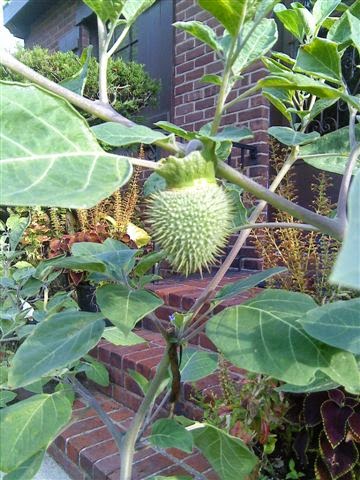
The Thorn apple (Datura stramonium)  is also known as Moonflower and  Locoweed. It is part of the Poison Family---lower left hand side. It is both poisonous and medically useful, as are its relatives in the nightshade family, Belladonna (Altropa belladonna) and Mandrake (Mandragora officinarum).

If you handle the Thorn apple’s seed pods carelessly, you will get pricked painfully. But when the pod opens, the seeds do their dastardly work. Toxic reactions are due to alkaloids that cause vision distortion, hallucinations, and can be fatal. Such is true with Belladonna and Mandrake as well. These are not plants to display in a garden club show and tell! Many of the parts of the plants are toxic; check your local poison plant directory.

The medicinal uses of these nightshade members are surprising: Datura was formerly an asthmatic medication, Belladonna is an eye medication, and Mandrake was used for stomach ills. 

Cornell notes their debilitating effect on livestock, USDA lists them as ‘noxious plants’; and Native Americans from long ago used them as hallucinogenic aids for ceremonies. 

You will find an exhibit in the Cloisters herb gardens in their "Magical Herb" section. There are many others which could have been part of the same Garden, such as Foxglove and Mayapple---but this will wait till another Halloween.


A closer view of the Thorn apple---see the prickly pods?


Sources (some) 
U. Michigan: Native American Medical Plants Database 
FDA: Poisonous Plants Database
 A Modern Herbal 
Cornell University’s Ag Extension publications 
USDA .

Just Basil

FROM THE URBAN HERBAN’S NOTEBOOK: 
BASIL

Basil & Tomatoes are the Peanut Butter and Jelly of Vegetable Land. 

The last basil needs to be harvested before it disappears into the frost, to be grown in the home garden---next year.

The best tasting basil, if plucked, in July or August can be part of Sicilian Tomato and Basil Salad. Take a tomato, quarter it, drizzle freshly made  oil and vinegar dressing over it, and top with sliced thin basil.  

Also, try a Many-Basil Pesto: use Genovese Basil with others, such as Cinnamon, Lemon, or Pistou, the French contribution. Each blends for a piquant pesto.

Basil is past its prime, which was July 21; it lost some of its volatile oils. It would be best in stews and sauces. Just dry it carefully and store in a brown glass jar (Why? Chemists have figured out that the volatile oils will not seep through the glass, as they do with plastic. )

Or, store in the fridge, to be used a bit at a time when you wish.

Basil comes from India and spread quickly to the Mediterranean, thanks to travelers. It was used medicinally to cure coughs and colds, just like its relatives, the mints.

 It was originally considered dangerous, and it was believed that a pot of basil hid a scorpion under the pot base (Do you believe that one?)

Program at Van Saun for Children: "Just Basil"

https://www.scribd.com/doc/248655680/05232014-Latest-Van-Saun-Desc-Adults