Friday, July 15, 2011

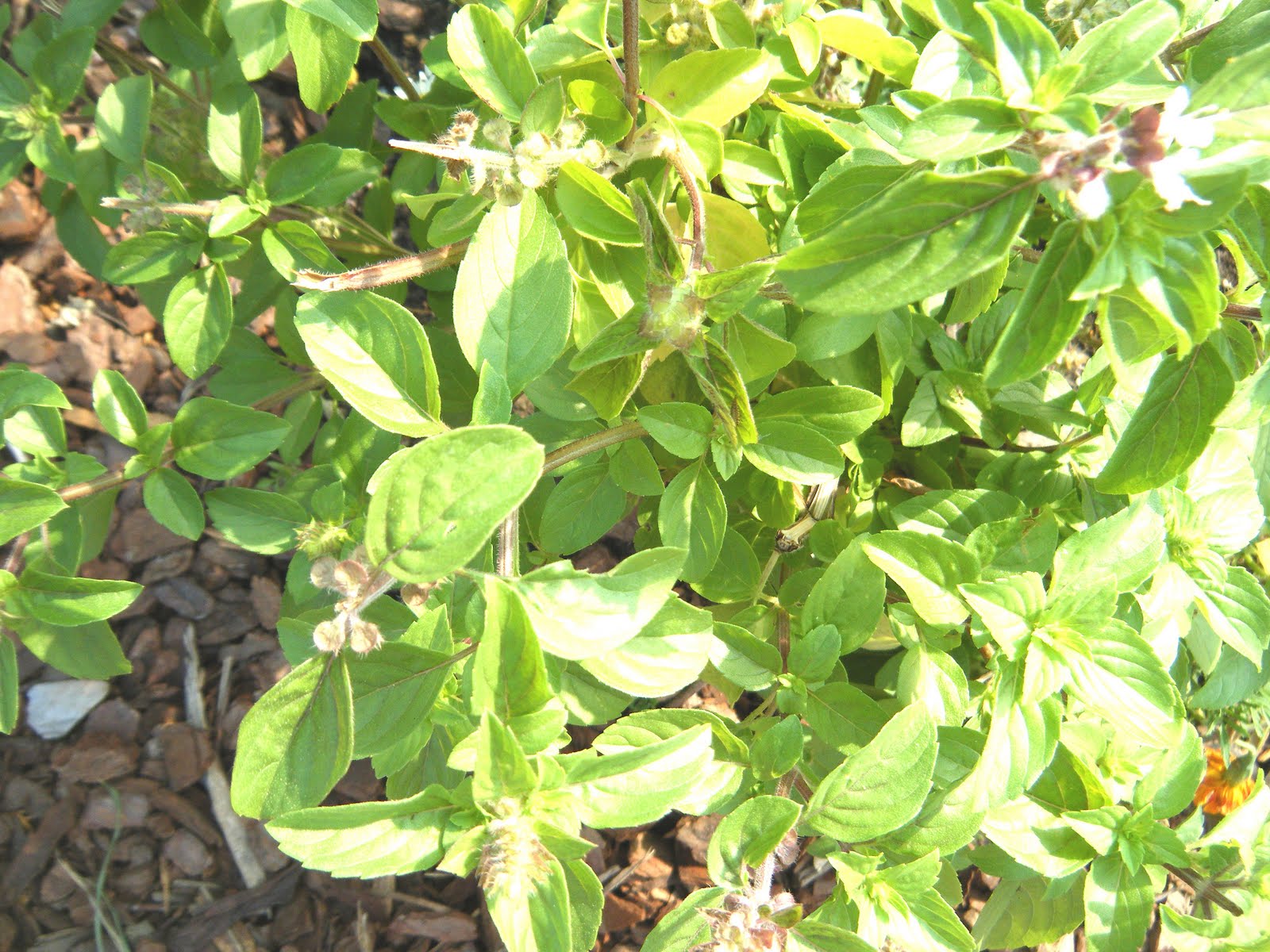
Recipe: Lemon-Basil Drink

This recipe from Marty Steeil, and was used at the Herbal Iced Tea Workshop. This is perfect for today, which is blistering hot, up to 100 degrees and more.
Perhaps a section on Herbed Iced Beverages will show up here in August.This is the first, albeat it in July:

Marty's words: "I made the lemonade with a very simple recipe:

a. Buy a 2 liter bottle of lemonade
b. Put a half ounce of basil into a blender and half the lemonade
c. Blend on high for 1 minute and pour into a container
d. Repeat with the rest of the lemonade and another half ounce of basil. Pour the rest into the container.
e. Put the container into the frig and everytime you open the frig for the next 24 hours shake the container
f. After 24 hours strain the mixture through cheese cloth or a very small holed strainer (get out all the green).

It is best served ice cold. It tastes great alone. It also makes a great base for adult drinks.

Enjoy!"
________________________________________________
The next Herb Workshop will be in late August or early September, stay tuned for the exact date. It will be on on Harvesting and Preserving Herbs. The time is 9:30 to 11:30 AM on the Greenhouse Lawn, at the end of Lindbergh Blvd. We are going to feature a tour of Greenhouse Gardens, with gardners there to discuss their practice. The demonstrations of herb preserving methods will be centered on herbs for That Summer Taste All Year Long.
DISCLAIMER:

The statements made here have not been approved by the Food and Drug Administration. These statements are not intended to diagnose, treat or cure or prevent any disease. This notice is required by the Federal Food, Drug and Cosmetic Act.

Monday, July 11, 2011

A Five-Herb Pocket Garden


--- Find a spot that gets sun at least six hours a day.

--- Make your plot fit the area----about a 4 feet square area is enough for a pocket herb garden.

---Sow parsley in late March. Add dill, cilantro, oregano. Sow basil last (mid-June).

---Allow for growth --find out the size of the mature plant.

---- Water regularly and make sure the plot stays weeded.

---Harvest when there is enough of the herb that some will still grow, Snip the tips of large leaves for the flavor. Remove stems (they are usually bitter) from oregano and use the leaves from cilantro and dill.
---Rinse and pat dry; use in recipes for that fresh herb taste.

---Basil will grow large over the summer; pinch off the flowers to keep the plant growing;cilantro and dill should be sown again as cool weather approaches.

--Parsley will return for another year; oregano is a perennial, and as the season ends, so does the basil.


Have a partially shady area? Try Parsley, Chives, Lemon Verbena, Mint, and Sage.
A surprise addition is Breton Shiso. I grew seven Shiso plants this summer in my pocket garden under the trees. They had coloring of purples underleaf, dark chartreause on the upper leaf. I transplanted two of them to full sun, and each grew vigorously. I compared them to the five in the pocket garden, and the height is not appreciably different.

Saturday, July 9, 2011

Herbs: How They Grow, Where and How to Plant Them and More


Herb Society of America. Everything, from “this year’s herb” (Horseradish) to guides for the 400 public herb gardens in America.
www.herbsocietyof America.orgHerb Companion. Recipes and practicalities.
http://www.herbcompanion.com

Information About Herbs, Botanicals and Other Products Sloan Kettering site: http://www.mskcc.org/mskcc/html/58481.cfm. See how healing the herb actually has proven to be in research.


Two Sages: Common and Tricolored

Herb Gardening, Recipes & Design Books

Rodale’s Illustrated Encyclopedia of Herbs.
Claire Kowalchik & Willian H. Hylton (Eds.).Classic (any edition.)
Check each herb you want to try.


For a formal herb description, use Tucker and DeBaggio’s Encyclopedia of Herbs: A Comprehensive Reference to Herbs of Flavor and Scent.

Herbal Teas for Lifelong Health
. Kathleen Brown. (A Storey County Wisdom Bulletin.)This small book packs methods of preparation, recipes and notes about healing herbal teas. Adapt the recipes for iced teas.

Homegrown Herbs. Tammi Hartung. Has the single best set of charts on conditions for each herb’s propagation and use.

The Story of Tea. Mary Lou Heiss. Largely focused on the vast array of Oriental teas and the judgment of "what is a good tea".

Your Backyard Herb Companion. Miranda Smith. The emphasis is on manageable and beautiful spaces for 100 herbs. The pocket size space plans fit Teaneck well

Teas: Where to Find Them

Garden States House of Tea lists the teahouses in the state. A number of them serve and sell loose herbal teas. http://www.teaguide.net/tearoomsnewjersey.htm

Oradell: Cool Beans.ns. About 30 varieties (Including lavender).

Whole Foods, Paramus and Edgewater: has loose teas, notably mint.

Fort Lee: Kudo Beans: Wide array of herbal teas in tins.

Friday, July 8, 2011

Ever Notice the Noxious Names of Weeds?


This is not a weed, although the name Wormwood puts it with them. This is an herb with a dubious reputation, having been used for making absinthe. In the past, it was used as a strong purgative, and brought on body convulsions.In the picture, Artemis absinthus is in flower. I planted a number of them for decorative foliage,for which it is used now.

But look at the common weeds we try to keep out of gardens.
Look at their names :
Redwood Pigweed,
Nodding Beggar-ticks,
Great Ragweed,
Canada Fleabane,
Marsh Cudweed,
Poverty Weed,
Sticky Groundsel,
Puncture Vine...
Hardly attractive as names.
Not all are evocative of the worst, but most are!


Take some time with a weed identifier book.With one you can read the ugly names in two languages:
Royer, France and Richard Dickenson. Weeds in the Northern U.S. and in Canada (1999).Foreword by Shafeek Ali, Provincial Weed specialist (Bet that's a job title you haven't seen.)Alberta, CA: Lone Pine Publications.

One of the very best documentation parts of the book is the listing for each weed its dangers for livestock, humans, waterways, as well as a picture of the plant as seed, seedling, and grown plant. This book shows the waterways endangered by the Cattail (not the reverse(.


The Rutgers University Agricutural Dept.has a weed identification database:Online Weed Gallery:http:// njaes.rutgers.edu/
weeds/


Use the identifier, but more important---get rid of them. Read Ray Edel's recent column to see how.Although this cattail is not as ugly sounding a name as other weeds, it is a USDA -recognized weed, clogging many canals in Florida.Cattails: Great Swamp near Gillette, NJ,


---Urban Herban

Thursday, June 23, 2011

Lemon Verbena-Mint Iced Tea!


Lemon Verbena in a swirl---seen in July 2011 in my garden

Ingredients
1) 1/2 cup of fresh mint leaves (not the stems, they're bitter), rinsed, lightly packed (about 20 leaves)
2) 1/2 cup of fresh lemon verbena leaves, rinsed, lightly packed (about 10-15 leaves)
3) 2 cups of water

Method
1)Bring a pot of fresh water almost, but not quite to a boil.
2)Put the mint and verbena leaves in a teapot. Pour the hot water over the leaves.
3)Let sit for 3-5 minutes.
4)Strain into tea cups. Makes 2 cups.

For Iced Lemon-Verbena-Mint Tea: you need to have a stronger base so the water won't dilute the tea. You can let the tea cool after removing all the leaves. Then serve over ice.


Orange Mint in my shady garden, backyard

---Urban Herban

Op Ed piece:“Tomatoe” can be spelled like Quayle’s “Potatoe”

Green Zebras maturing

Just kidding.


Urban Herban

Tuesday, June 21, 2011

7 Ways to Find Grants for Community Gardens


Oregano in blossom

Looking for resources to fund the local comuunity garden can be compared to looking for the pot of gold at the end of the rainbow.But that gold is there, say all leprechauns. To begin,take the time to look at municipal-sponsored gardens and greenhouses on the web (NJ) and see how others support their community resouces.

Examples of NJ Municipal Greenhouses from the Internet
Maplewood NJ greenhouse contains some ideas that could be adapted to Teaneck: These include renting out spaces to citizens, first come, first served, for vegetable and plant growing. Greenhouses are on town property and maintained financially and otherwise by the Garden Club. This club, started in the 30s,received a national award for the effort.Belmar, NJ: Magical Gardens Started in the 80s. Municipally supported. Club also rents space to people for gardens, as well as indoors.

Grant Resources: You have to dig in here, with a focus on looking for grant opportunities that meet your purposes. Grants get given for limited periods of time, for specific purposes and usually getting one is quitecompetitive.< You will be filling out an application

Usually, grants from the US or State governments are given to groups with well established reputations (university, research, etc.) An exception is in education, in which numerous mini-grants are tied to elementary education. Community groups are eligible for some. Any such award would need members who know how to write curriculum and specify standards.

Learn about proposal writing: A Foundation Center Free Course Online. Then the resources will make more sense.
In the past, have downloaded a number of proposals that show good ideas that won grants. One was to use computer heat to warm up a greenhouse (Indiana, 2009.) If you are interested, write me (urbanherban@hotmail.com.)


State links: The New Jersey Agriculture Dept. has information, case studuies, descipyions of projects and several specific kinds of grant opportunities.There are qualifications, deadlines and forms to examine on your quest.

Federal links: This is the largest grants database available for free. The Foundation Center’s database costs $2,000 a year to support looking for opportunities in the corporate and non-profit world.

Look at qualifications, forms, amounts, and deadlines:http://www.grants.gov/ Estimate what to start with--usually, a well thought out problem statement or proposal.


Associations: Some garden associations have mini-grants for working with children. Connect with The National Gardening Association of America and look at their listing of grants. Kids Gardening has a listing of these on http://www.kidsgardening.com/grants.asp.


University Databases: Rutgers Agricultural Sciences Subject Guide.You will find ideas in the databases assembled (horticulture, environment, water use, etc.).

Corporate Resources. Considering the amount of literature from companies done with university partners for energy efficiency, it is smart to look at company and university research literature. For instance, if you use “drip irrigation“ as a search in Google, will find Center for Irrigation Technology. Look at what is being funded and by whom. It can inform your proposal,

Beyond Databases: One Specific Book. Foundation Directory. Part 2: Guide to Grant Programs, $25,000-$100,000. Call Number: REF 061 FOU PART 2 2009 ED This directory includes foundations by name, state, subject---and has material on what organizations were funded, with how much in funds. Restrictions in funding are listed. You will be surprised how many small foundations there are, as well as the activities they support.